My collection of works is called “Being Adversarial and Getting By.” Almost every project I did is adversarial or hostile to the government or institutional power. For example, I created an Apple shortcut to spam emails to the “Department” of Government Efficiency to bog them down and make their inbox sorting less efficient. At first it just seemed like a funny thing to do, but it was actually a coping mechanism for what’s going on in the American government. I (and thousands of others) feel so helpless as I watch our descent into fascism. After I’ve called my representatives and looked through hundreds of posts about how to help stop it, there’s still this pit of anxiety in my stomach. And it feels like it almost never stops. Trump is attacking higher education. Revoking student visas. Oh, now Trump is trying to deport American citizens to a torture camp in El Salvador. My phone beeps and now the White House tweeted, “DO NOT RETALIATE AND YOU WILL BE REWARDED.” That’s just a regular Tuesday now. Only 100 days in and we’re already at the lowest point America has ever been at.
I see all of my works as ways that I “got by” during the first 100 days. I had spent so much time volunteering, registering voters, and building momentum for the election to go my way. I thought there was no way Americans would put us through another Trump administration. I was obviously wrong. Through my creative process for this collection, I finally felt like my steam valve was released and I wasn’t on my phone being force-fed content about whatever Donald Trump was doing or saying at the current second. I channeled my rage and confusion into something positive and meaningful. Creating these various digital art, projects, and remixes was a cathartic experience. My first hack was a simple recreation of an Etch-a-Sketch that I felt unconnected to, but once I realized my projects could say something about the world we’re living in, they became more important to me. I actually enjoyed having to slow down and work on them. As a result, I wanted to create things that other people could theoretically use (if they were released) to distract themselves from this crazy political climate, or at least entertain themselves for a little while. If not, maybe it would at least make someone stop and think about an issue.
Etch-a-Sketch: 65 Year Anniversary Remaster
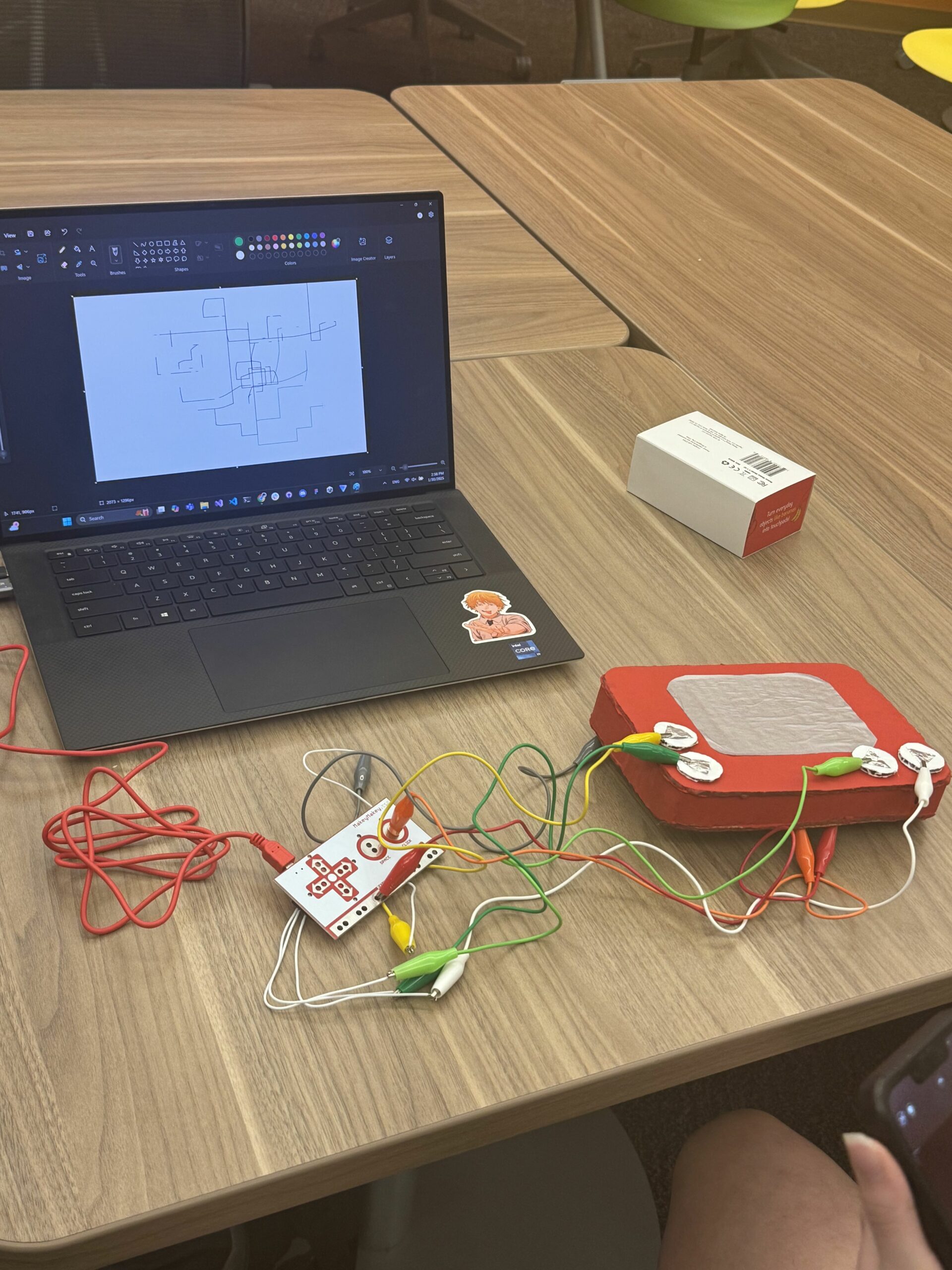
This project remediates a popular toy, the Etch-a-Sketch, by connecting Microsoft Paint to a physical cardboard body using makey-makeys. The intention of the project was to remediate an old, physical toy, the Etch-a-Sketch, into a digital form. Both the Etch-a-Sketch and Microsoft Paint are nostalgic for generation Z, so the team created something that merged them together but kept the design of the original. Merging both items together was supposed to subvert nostalgia, but in retrospect, it actually ended up enhancing it.
Flog: When it came to crafting our Makey-Makey Etch-a-Sketch, Lillian and I ran into the most trouble figuring out how to make the buttons true to a real Etch-a-Sketch. We wanted to find a way to make only two buttons that would turn and move the pen left/right for the left button and one that made the pen move up and down on the right side. Unfortunately, we failed to find a way to make that happen because it would require splitting the button in half so that it could be controlled by two different clamps of the Makey-Makey, but then that would not be able to turn like a dial.
During this video there was a problem with the lines skipping, which was not a problem during our other demos.
Fuck the Meritocracy
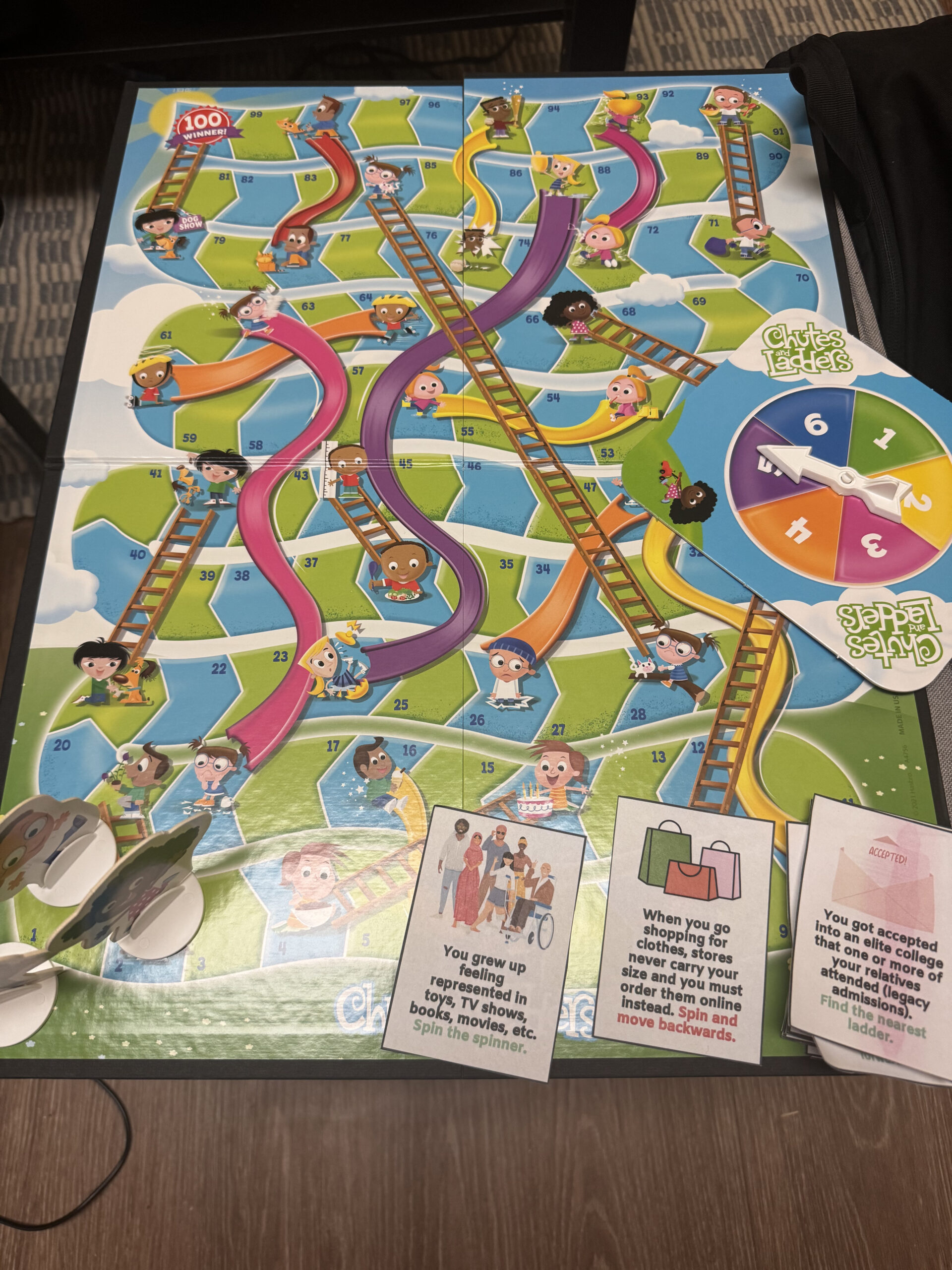
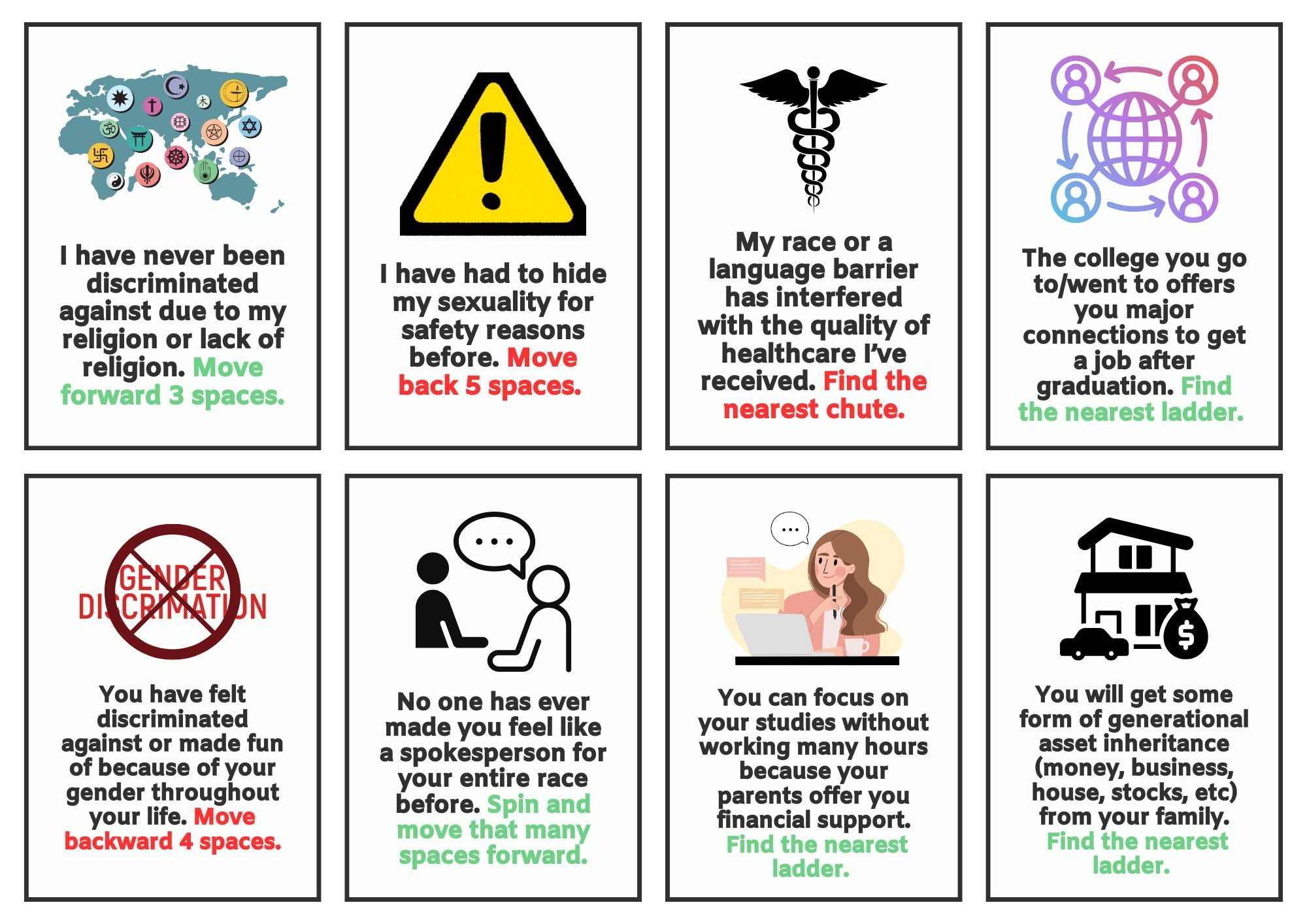
Fuck The Meritocracy points out the absurdity of removing DEI programs across the country by remixing the children’s game “Chutes and Ladders.” Instead of spinning and moving a number of spaces by chance, players must use a randomized set of privilege cards, and move up a ladder, down a chute, or forward or backward depending on how they relate to the card. Other than that, there are no rules, which is meant to cause chaos and emulate what it can feel like to have few privileges/limited social mobility. Players can decide on rules in the moment by having real discussions about what is fair and unfair when it comes to individual privilege.
Flog: First, I had a really hard time figuring out which board game was best to convey the idea because I actually never played chutes and ladders as a child. I thought of all the board games I knew, and none of them had the correct set up for the upward mobility I was trying to convey. I was in Target in the board game section, and I noticed chutes and ladders, and that it was the only board game that wasn’t like $25. It literally had the perfect set up, so I bought it and didn’t need to make physical changes to the game board.
Department of Spam Email Efficiency
When Elon Musk was first appointed to lead the Department of Government Efficiency, he asked all federal workers to send him an email detailing five things they did in the past week. While Musk said it was a “pulse-check” for federal workers, this software allows anyone to check in with the department. It automates the task of writing emails to doge@mail.house.gov, a hotline for reporting government inefficiency. The automation uses Apple Shortcuts, which is meant to automate helpful tasks, like translating text or turning a video into a GIF. This project subverts the expectation of a helpful algorithm into one meant to annoy and overcrowd DOGE’s inbox, making it so they can’t get to all their emails efficiently.
Access shortcut for use here.


Justice for All?
This video compilation juxtaposes newscast announcements of prison sentences for mass shooters (typically life sentences) with the announcement of the death penalty in Luigi Mangione’s case. It explores the relationship between the material wealth of an individual crime victim and how the state imagines justice. Additionally, it shows clips of officers being acquitted in police brutality cases like Breona Taylor’s murder. When students or black and brown bodies are murdered, their killers do not get the death penalty. Justice in America is often not for all, even if Americans imagine it to be.
Flog: I’m also considering a project that compares the sentence Luigi Mangione is facing (death penalty) to the sentences faced by mass shooters to comment upon the value of life in America.
Transit
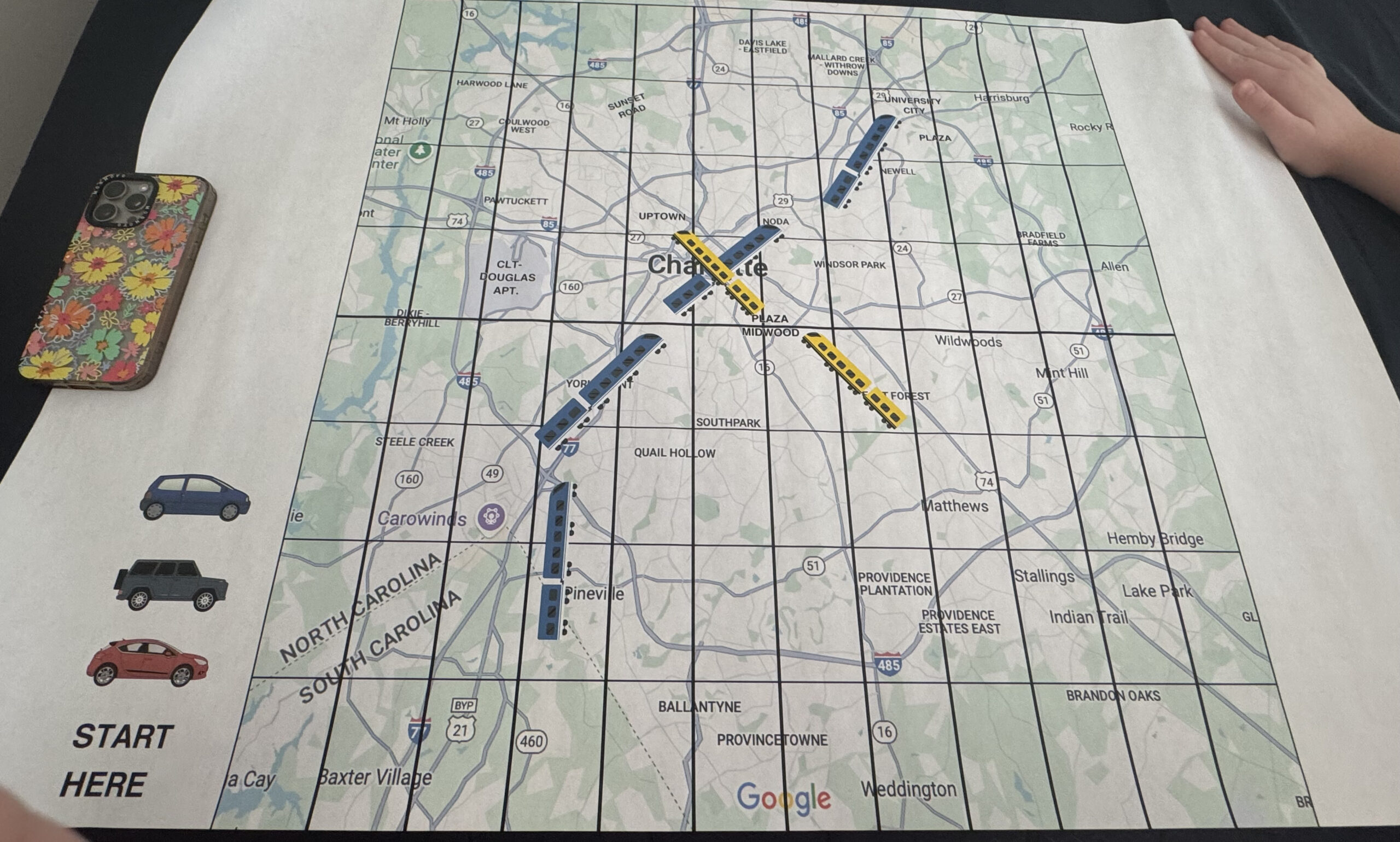
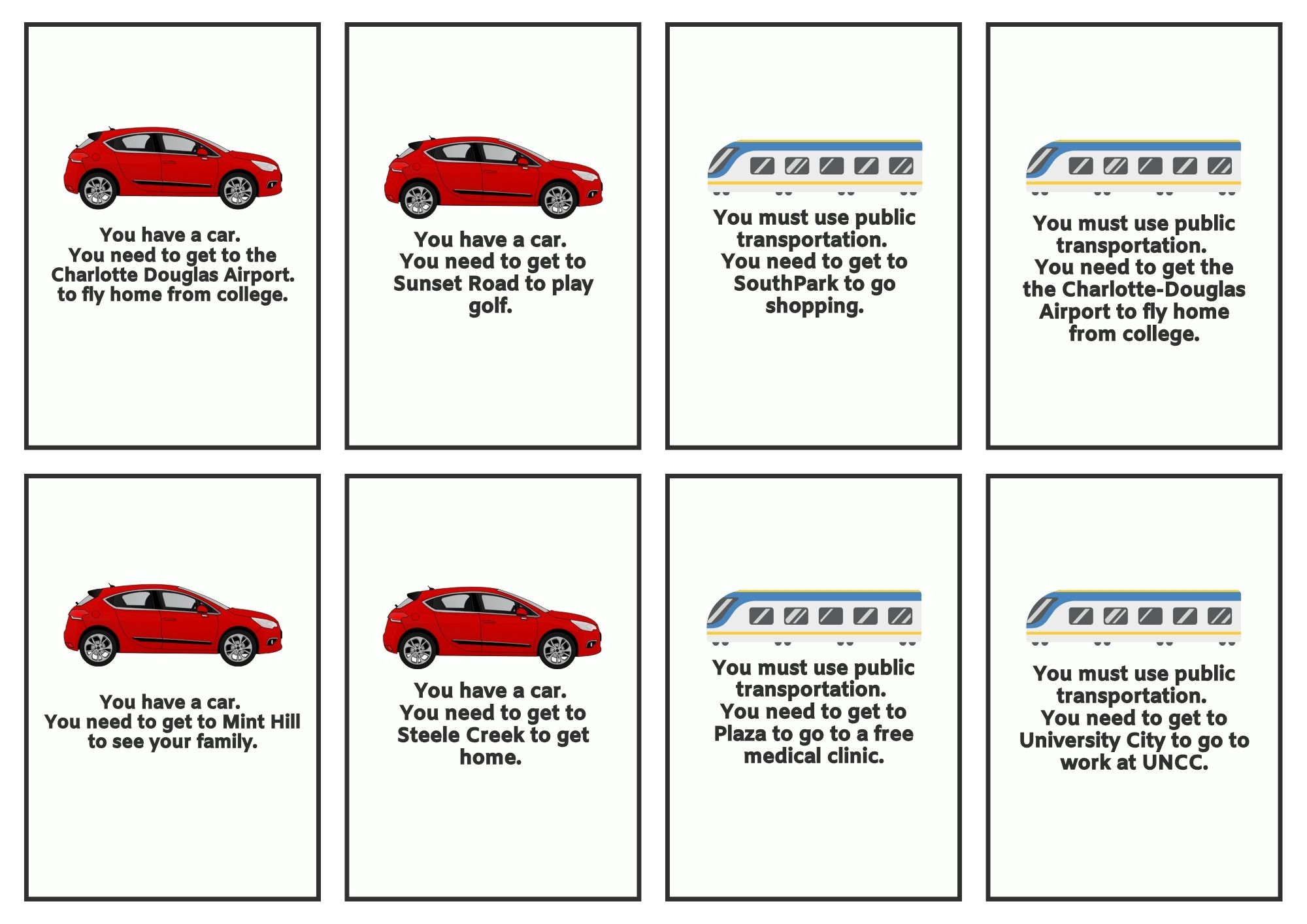
Transit highlights the state of public transportation by bus and train in Charlotte, North Carolina. It uses the grid system of “Chutes and Ladders” with cards that assign players the role of car owner or public transportation rider. Car owners get to roll two dice to naviagte the board, while public transportation riders get to use one dice. They can take the ladders, or trains, that will help them get to certain locations but be useless to get to other locations. Among other things, the game reveals that a large part of Charlotte has no train access, and those communities are typically extremely wealthy, or they are poorer communities facing gentrification.