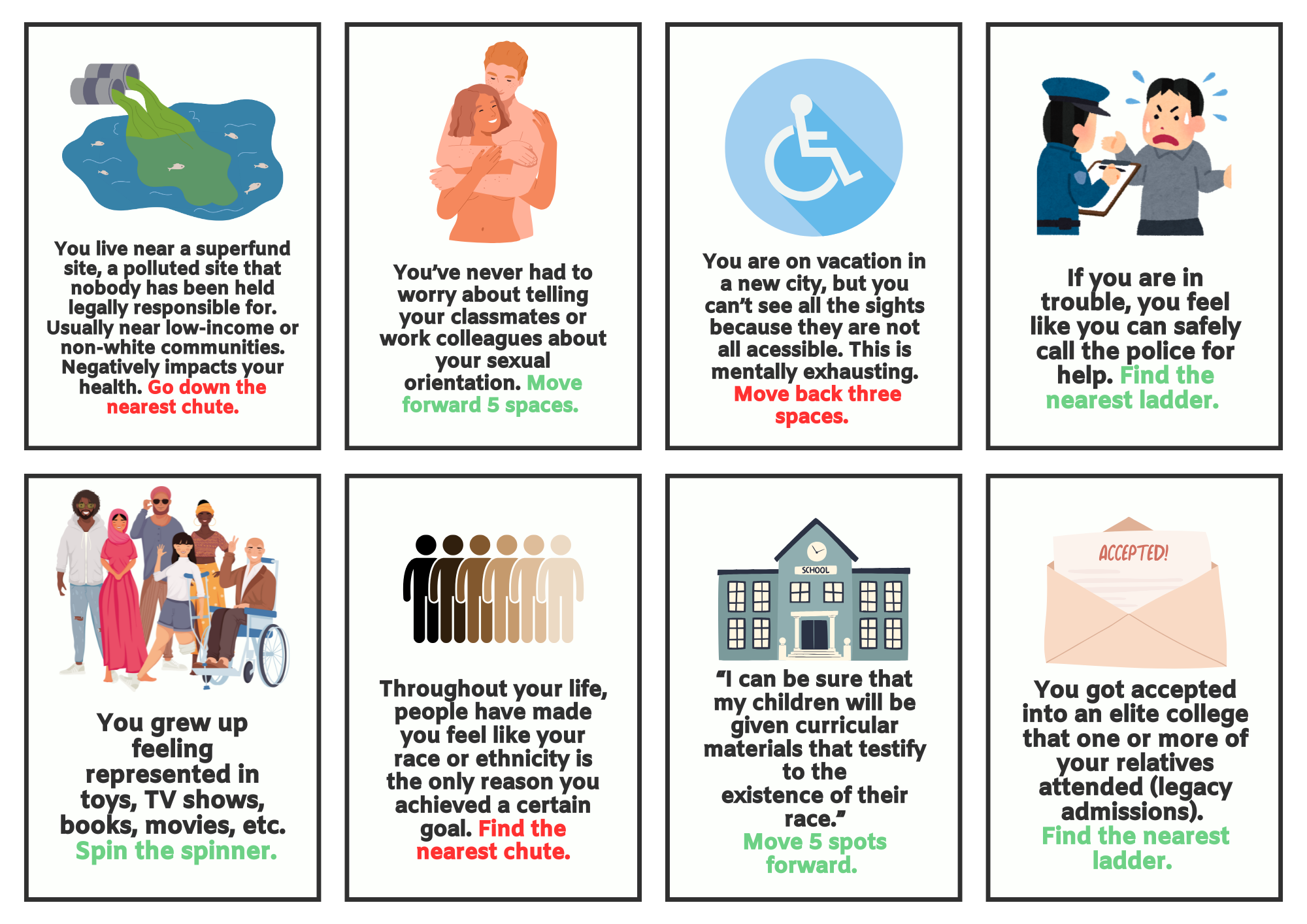
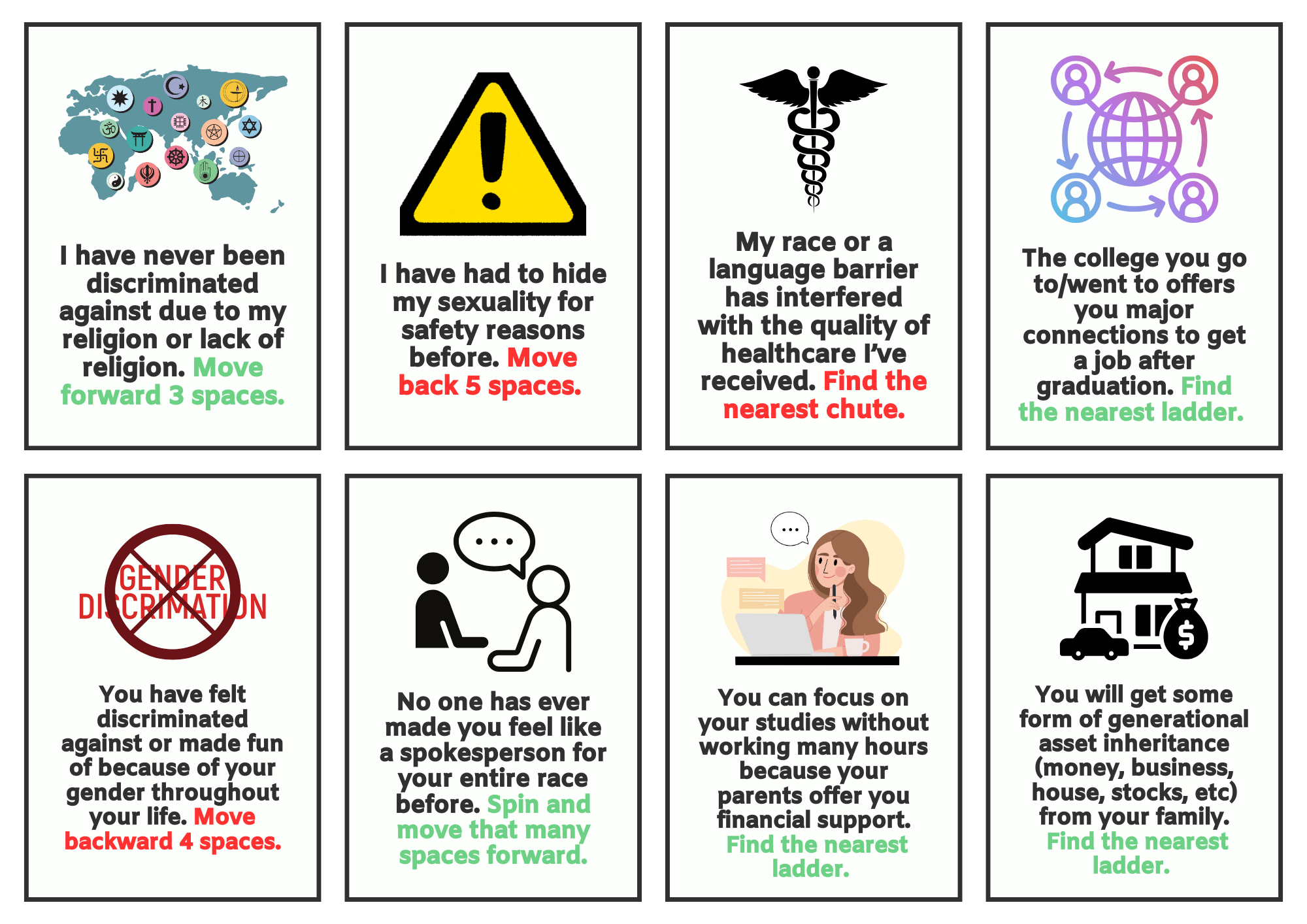
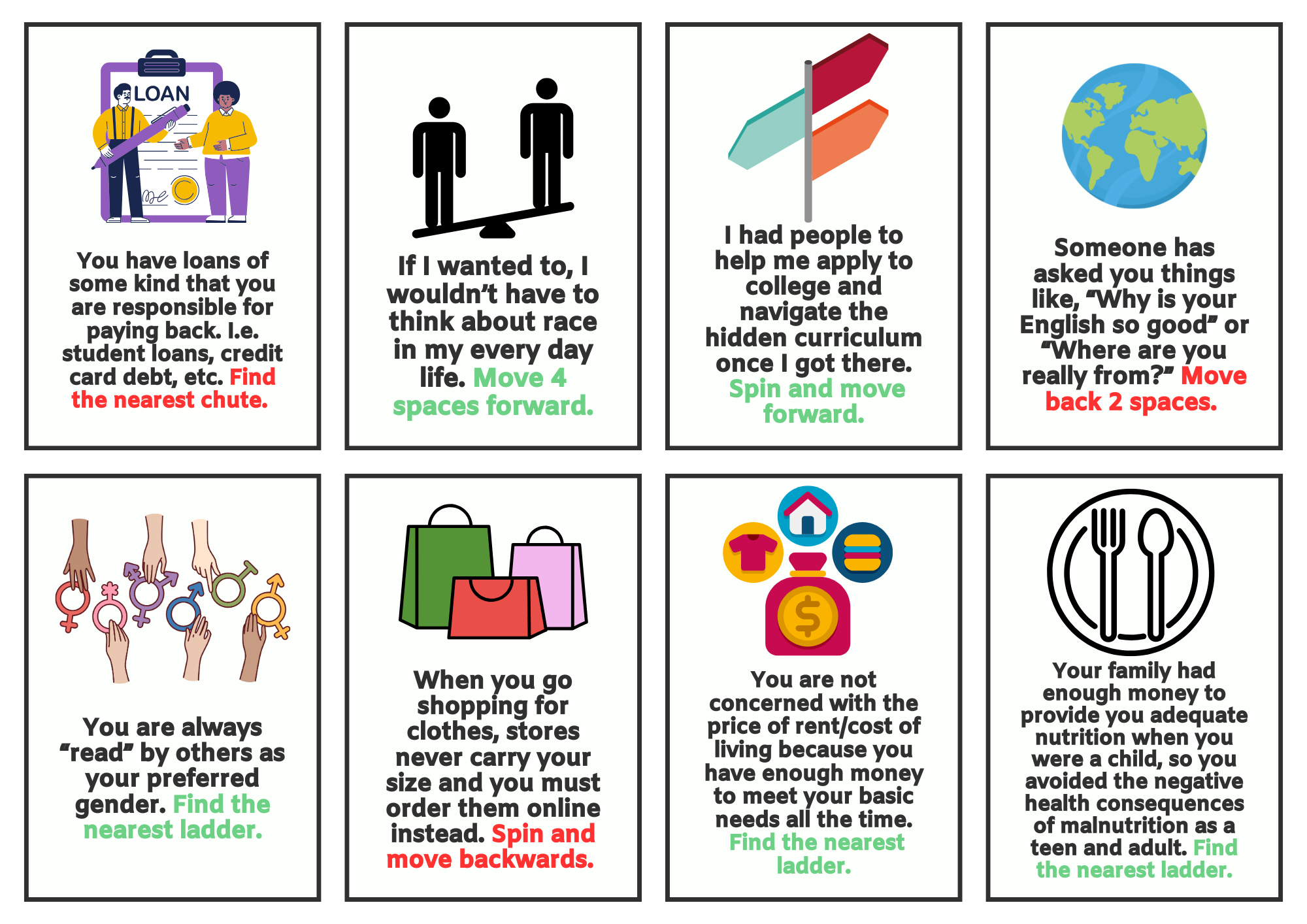
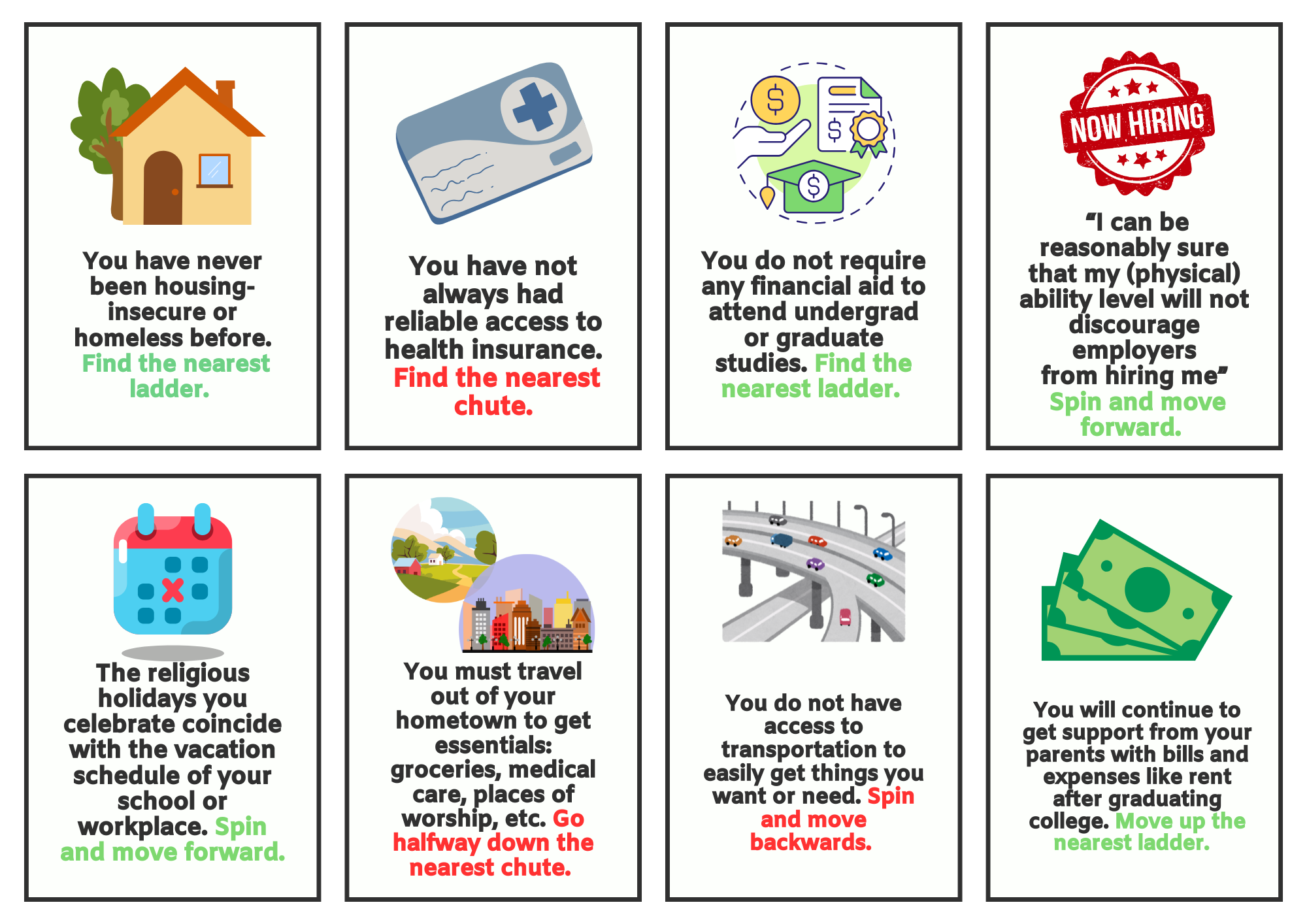
For my second hack, I chose to redress the popular children’s game “Chutes and Ladders” to a game called “Fuck the Meritocracy.” You move forward in the game by first drawing cards with movement instructions. Each card also has a small blurb about a privilege statement. For example, “I got into an elite college that one of my relatives attended.” If that is true for the player, then they climb the nearest ladder. Lack of privilege makes a player move backwards or down the nearest chute. The final product is adversarial design because I think playing it makes players reckon with the privilege they have and sometimes the privileges they wish they had. First, I think there’s a tendency for a lot of extremely privileged people (specifically the ultra-rich) to downplay the resources they have and how those resources propel them to the top of society. Fuck the Meritocracy does not allow for that: if a card is true for you, you have to move. It might even motivate those people to admit ultra-privilege out loud so that they win a game. The game also forces those people to think critically about their advantages. If they got to the top of the board in four cards while everyone else is lagging behind, then they can see the inequality in a tangible way. Those who can (unfortunately) relate to every other inequity card and those who acknowledge their privilege probably don’t need a game to demonstrate this.
The game is also directly adversarial to the attitude that you can “pull yourself up by the bootstraps and life will be awesome.” You’ll get the job you want since you’ve worked so hard. You’ll earn a bountiful living that provides for you and your family’s dreams. Right? No. The project also channels Carl DiSalvo’s “Agonism,” particularly something he said about it in an interview in 2012. When DiSalvo was asked what Agonism is, he said “Agonism is the truth that your neighbor already knows. Legislation doesn’t solve anything. The conflicts continue regardless; it’s just the nature of politics.” In the same vein, I argue that every person who has worked in the past 10 years knows that the idea of pulling yourself up by your bootstraps is no longer the case. For a lot of marginalized groups, it was actually never the case. Asserting that everyone is on an equal playing field in life only obscures the systemic inequities people face. Dunne and Raby talk about “Speculative Design” as design that imagines different possibilities in the future. I aim to demonstrate how the bootstrap and meritocracy attitudes are one possible way to view life, but that is bullshit, so we should pick a different possibility.
My game doesn’t have written instructions in the spirit of being anti-structure. All I’d tell players is that there are as many ways to play as they can think of. You can play with a group of people or by yourself. When I played the game, I read each card and if it applied to me, I moved according to the card instructions. If a card did not apply to me, I chose to do the opposite of what it said. You could also play a version where you don’t move at all if a card applies to you. You could play as if you have the privileges you wish you had, though I did not intend the game to be aspirational. The game is probably most impactful when multiple players are playing, though. The final product encourages people to think of how some people are held down in society and don’t get the same tools to “move up.”
This game is especially relevant in a political landscape where the federal government is trying to get rid of the programs that try to level the playing field for everyone. After I thought of the concept for Fuck the Meritocracy, I started to doubt myself, like is this creative or cool enough? Will it actually get people thinking about what’s happening in the world right now and the positions we all occupy in it? I was reassured when I saw a flyer for an event that is bringing a speaker named Jeremy Carl to campus. Carl, a mouthpiece for the Claremont Institute, wrote a book called “The Unprotected Class: How Anti-White Racism Is Tearing America Apart.” I was reminded there are people who actively ignore the gendered, racial, and institutional advantages they’ve been given in life just by being born. I then felt like my idea came to me at the perfect time, and most definitely for a reason.
The cards I designed for the game:
Sources:
“Agonizing over ‘Agonism’: Exploring How Difference Can Fuel Democracy.” n.d. Accessed February 18, 2025. https://walkerart.org/magazine/agonism-politics-consensus-art-democracy.
Anthony Dunne and Fiona Raby, “A/B” and “Design as Critique” from Speculative Everything: Design Fiction and Social Dreaming (2013)
Carl DiSalvo, “Design and Agonism” from Adversarial Design (2012)
“Examples of Privilege | North Shore Community College.” n.d. Accessed February 21, 2025. https://www.northshore.edu/about/initiatives/diversity/equality-and-equity-project/examples-privilege.html.
